Walala Tjapaltjarri
DOB: c.1969 -
BORN: Marua, WA
LANGUAGE GROUP: Pintupi
COMMUNITY: Kiwirrkurra, WA
A Pintupi, Walala was born in the late 1960s at Marua to the east of Kiwirrkura in the Gibson Desert.
Walala and his family created international headlines when they arrived out of the wilderness of the Gibson Desert in 1984. Till this time the group had been following their traditional lifestyle in the country of Lake Mackay. The last known group of people to make contact with white society, they survived for so long in the harsh environment of the Australian desert through their intimate knowledge of the land and its secrets, passed down from their ancestors for thousands of years. His home base is Kiwirrkura, the most remote settlement in Australia, but as he is married to a Warlpiri woman, Brigette Napangardi, he also spends time in her country, Yuendumu, Nyirrpi (Alice Springs). He is occasionally assisted by his wife in the dot work in his paintings.
Walala was introduced to the art by his brother Warlimpirrnga, also an acclaimed artist, who instructed him in the use of acrylic paints and canvas. He began to paint his own works in 1987 while still in his early twenties. His first works were in the style of traditional ground and body painting and up until 1996; he painted in the 'Papunya Tula style' (roundels, abutting lines and U-shapes set against an in-filled dots background).
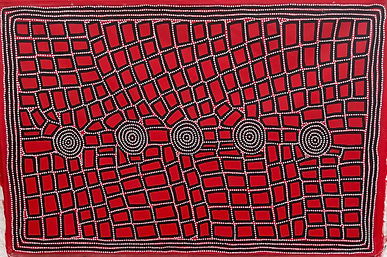
In a short time, however, he developed his own rhythmic visual language to depict country and ceremony. The subject of his paintings is the Tingari Cycle, a series of sacred and secret mythological songs for men. The Tingari are a group of Ancestor Beings who travelled through the land performing ceremonies to create and shape the country associated with Walala's many Dreaming sites, stretching from near the West Australian border to Central Australia. Among them, eleven sites are located throughout his traditional country near Lake Mackay such as Marua, Minatarnpi, Tarrku, Njami and Yarrawangu, including Mina Mina, a significant women's ceremonial site where his family used to spend time. These Dreaming sites and songs are depicted in the traditional ochre colours of the desert.
The rectangles of Walala's paintings map both the physical and spiritual dimensions of his sacred country, and his mastery of structure and composition put him as an artist at the forefront of contemporary painting.
Tingari Cycle
Medium: Acrylic on Linen
Size: H - 1200 x W - 1800